
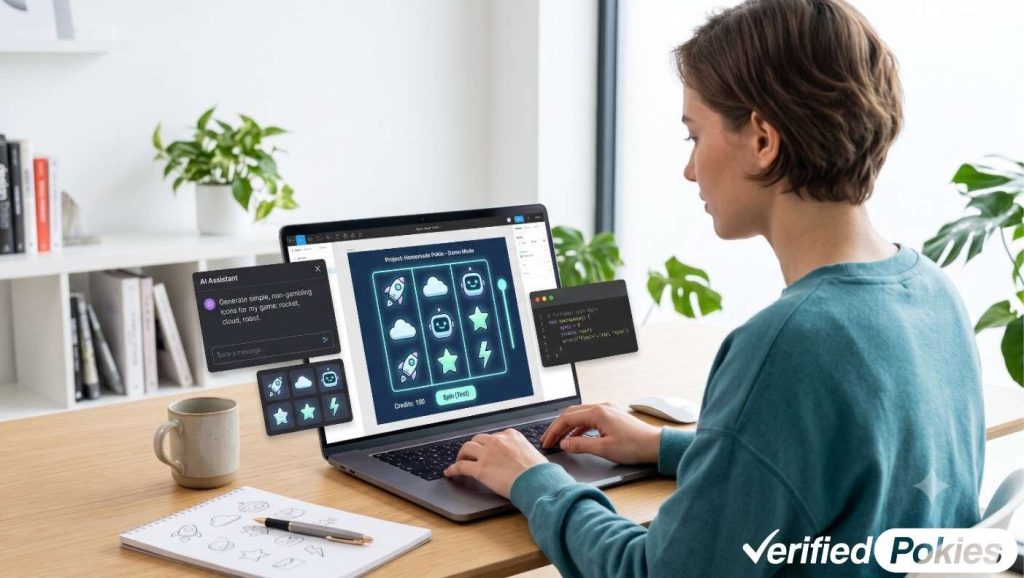
Pokies are the most played games in Australia — online and off. So it’s not surprising that some players, developers, and curious minds start wondering: could I build one of these myself?
The short answer? Yes. And in 2026, you don’t need a computer science degree or a six-figure budget to do it. AI has made building a basic pokie game genuinely accessible to everyday people — as long as you’re doing it for fun, not profit.
So, Can You Actually Build Your Own Pokie?
Absolutely. Building a pokie-style game as a personal project, creative experiment, or portfolio piece is very much possible. The mechanics — spinning reels, symbol matching, a random number generator, maybe a free spins round — are well-understood and relatively straightforward to recreate in a simple browser-based format.
What’s changed recently is that you no longer need to write every line of code yourself. AI coding assistants can do the heavy lifting, turning your idea into a working game in a fraction of the time it would have taken even three years ago.
How AI Has Changed Everything
Traditionally, building a slot game required a developer who knew their way around Unity or HTML5, a designer for graphics, and a sound engineer for audio. It was a team effort with a real price tag attached.
With AI tools like ChatGPT, you can accelerate the process — automating idea generation, code scaffolding, storyboarding, and even game logic creation.
That means a non-developer can now describe what they want in plain English — “a 5-reel pokie with an Australian outback theme, three bonus symbols, and a free spins round” — and get working code back almost instantly. It’s not magic, but it’s surprisingly close.
Tools You Can Use Right Now
A few AI-powered options are worth knowing about:
ChatGPT + Replit — One of the most accessible combinations for beginners. Use ChatGPT to generate the game concept and code structure, then use Replit to build and test it in a browser environment. You can tell an AI agent to build a slot machine with random number generation, winning line detection, spinning reel animations, and win multipliers — and get a working result without writing a single line of code yourself.
SlotGPT — Perhaps the most direct tool for this specific purpose. Launched on Stake’s platform, SlotGPT lets you describe a slot in plain text — setting, mood, bonus elements, gameplay features — and the AI automatically creates a playable slot. The process takes a few minutes, and you can generate up to 55 slots per day. It’s designed as an entertainment format rather than a serious development tool, but for curiosity and fun, it’s hard to beat.
Claude or GPT-4 for code generation — If you want more control, you can prompt any modern AI coding assistant to write HTML5/JavaScript slot game code from scratch. Describe your reels, symbols, paytable logic, and bonus features, and iterate from there.
What Goes Into a DIY Pokie?
Even with AI doing the hard work, it helps to understand what you’re building. A basic pokie has a few core components:
The reels and symbols — How many reels, how many rows, and what symbols appear on them. Classic setups are 3×3 or 5×3 grids.
The RNG (Random Number Generator) — The engine that determines each spin’s outcome. Common slot game programming languages include C# for Unity and JavaScript or TypeScript for HTML5-based games, with the right choice depending primarily on the platform and animation needs. M
The paytable — Which symbol combinations pay out, and how much. This is where you define the game’s feel — low volatility with frequent small wins, or high volatility with rarer but bigger payouts.
Bonus features — Free spins, multipliers, expanding symbols. These are optional but make the game far more interesting to play.
Graphics and sound — AI image generators can handle basic symbol artwork. Royalty-free sound libraries cover the rest.
From Idea to Spinning Reels: A Simple Workflow
Here’s a practical starting point for a no-code or low-code approach:
- Define your concept — Pick a theme, decide on your reel layout, and sketch out your symbol set and paytable
- Prompt an AI — Describe your game in as much detail as possible. The more specific, the better the output
- Generate the code — Ask for HTML5/JavaScript so the game runs in any browser with no installation needed
- Test and tweak — Play it, find the bugs, feed error messages back to the AI for fixes
- Add personality — Use an AI image tool for custom symbols and source free sound effects online
- Share it (responsibly) — Keep it private or share with friends — just remember the R 18+ classification rules if you publish it publicly
What You Can’t Do
To be clear about the boundaries: you can’t attach real money to your creation, you can’t let players cash out virtual winnings for real prizes, and you can’t market it as a real gambling product. If the game includes real-money betting or payouts, you will generally need a licence in the target jurisdiction and may also need certification from approved testing labs.
But here’s the thing — none of that is actually the point. Building your own pokie for fun is about creativity, curiosity, and getting a real sense of how the games you play are actually put together. And on that front, there’s nothing stopping you at all.
If the real thing is more your speed, VerifiedPokies has a full directory of reviewed Australian-friendly platforms, and the online pokies section covers everything from classic 3-reelers to the latest Megaways titles.
The Legal Bit (Quick, Painless, Important)
Before you open your laptop, a quick and genuinely important note.
Free or social games that do not involve gambling with real money are not regulated as gambling services under Australia’s Interactive Gambling Act. In plain terms: if there’s no real money going in or out, you’re not running a gambling service, and you don’t need a licence.
Social gaming with no prize — being either money or money’s worth — does not require any licence, given that it is not regarded as gambling under federal, state or territory law.
However, there are a couple of lines you shouldn’t cross. If your game allows players to cash out winnings or convert tokens to money, it can cross the line into being a gambling service. Advertising these games as a way to win real money or misleadingly representing the odds can attract scrutiny under the Australian Consumer Law and gambling regulations.
The takeaway: build it for fun, keep real money out of the equation entirely, and you’re on solid ground. When in doubt, seek legal advice before publishing or distributing your game.
Also worth knowing: video games that include simulated gambling — such as slot machine simulators — now receive a mandatory R 18+ rating in Australia, meaning they can only be sold or distributed to adults aged 18 or older. If you’re planning to share your creation publicly, that’s worth keeping in mind.
Final Thoughts
Building your own pokie is no longer a pipe dream reserved for game studios. AI tools have put the basic mechanics within reach of anyone curious enough to try — and provided there’s no real money involved, the legal path is clear.
Whether you end up building a polished five-reel adventure or a scrappy three-symbol prototype that barely works, the process gives you a genuinely different perspective on the games Australians love most. And that’s worth something, even without a jackpot at the end.